
Which is right for your project?
The choice of enclosure often doesn’t get much thought until something goes wrong. By then, the consequences can be significant – redesigning around a housing that was never quite right, or absorbing assembly costs that looked fine on a spreadsheet and nowhere else.
Indeed, there’s much more to making this decision than considering the upfront price. Here, we take a look at what to weigh up.
What do electronic enclosures do?
At its most basic, the enclosure keeps the outside world away from your electronics – water, dust, heat, knocks and electromagnetic interference (EMI/RFI).
But a housing that only does that is doing the minimum. The way a product goes together, how it manages heat, where components sit, how it feels to whoever picks it up – all of that is shaped by electronics enclosure design. In regulated industries, there are formal requirements to meet too: ingress protection ratings, flammability classifications and specific material approvals. Get the enclosure right and a lot of other things get easier.
Most manufacturers are choosing between two routes. Some will opt for catalogue stock, while others will use a housing designed specifically around their product.
Where off-the-shelf enclosures fall short
Standard enclosures make sense in certain situations. No tooling cost, fast availability, and a lower initial outlay make them a reasonable call for early-stage prototyping or low-volume builds where speed matters more than precision fit.
The trouble is that off-the-shelf plastic electronic enclosures are built to generic dimensions. When your PCB, connectors and other components don’t quite line up – and they often don’t – you end up adding brackets, cutting apertures or using adhesives to make things work. Each workaround adds time to assembly and introduces a potential failure point that a purpose-built housing can avoid entirely.
Environmental performance is another area where catalogue solutions can struggle. A product running in high humidity, chemical exposure or significant temperature variation needs a housing that’s been selected or designed with those environmental conditions in mind. A standard enclosure that gets most of the way there will not offer the same level of performance as one that meets the spec.
Aesthetics and branding matter too. A catalogue enclosure is, by definition, the same box used by hundreds of other manufacturers. For consumer-facing products or applications where the device’s appearance reflects the quality of the brand behind it, a generic housing sends the wrong signal.
There is also the matter of scalability to think about. What works at low volumes often becomes a liability at high volumes, where the inefficiencies of a poor-fitting standard enclosure – in assembly time, reject rates and material waste – can snowball quickly.
The benefits of custom electronic enclosures
With a custom enclosure, the housing is built around the product – not the other way round. This shift in approach often has a material impact on how well a product goes together and how consistently it performs.
Assembly is the most immediate gain. When mounting points, cable runs and connector positions are designed in from the start, production becomes faster and more repeatable. The secondary operations that eat into margins on a standard enclosure largely disappear.
In terms of product protection, a custom enclosure means you choose the material and wall specification for the environment your product will face. Bespoke electronic housings can be engineered for chemical resistance, UV stability or specific impact ratings – and features like integrated seals or EMC/RFI shielding can be built in rather than bolted on as an afterthought.
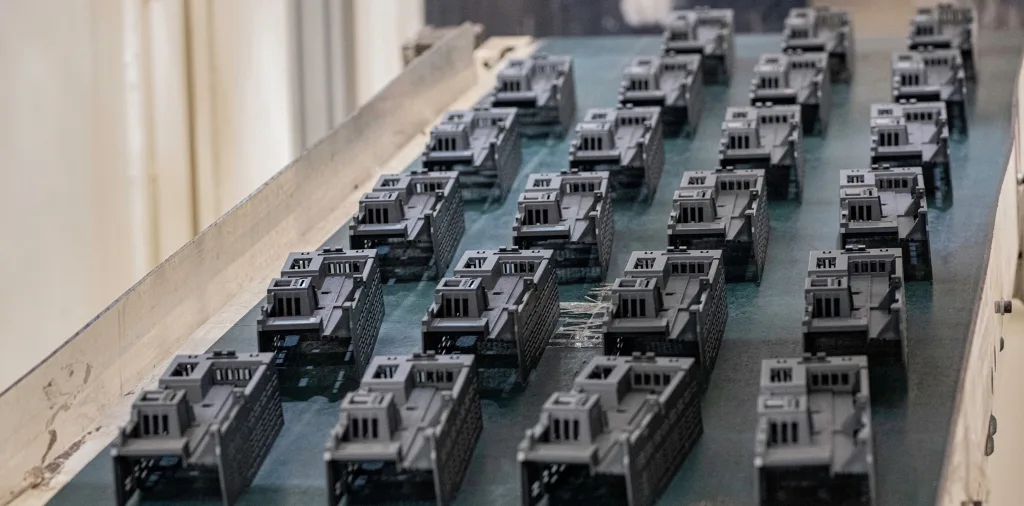
Plastic injection moulded electronic enclosures are the natural fit for custom manufacture. Injection moulding is well suited to the kind of precise, repeatable work that custom enclosures demand. Complex shapes, tight tolerances, high volumes – the process handles all of it, and the part-to-part consistency you get at scale is difficult to replicate any other way.
Material choice is also broader than many manufacturers realise. Injection moulding is compatible with a wide range of plastics, which means the housing can be specified for the functional properties the application really needs – whether that’s a lightweight material that reduces overall product weight, a grade chosen for its chemical or UV resistance, or a formulation that delivers a specific surface finish or colour straight from the tool. The end result is a component that’s durable, consistent, and built to last in the field.
When to go custom: key factors to consider
Production volume, product geometry, the operating environment and integration requirements are the four variables that matter most. If all four are straightforward, a standard enclosure may well serve you adequately. Where any one of these factors pushes into more demanding territory – complex geometry, harsh conditions, tight assembly tolerances, or volumes that justify tooling – custom is usually the most sensible path to take.
On cost, the comparison between custom vs standard electronic enclosures is often misunderstood. Tooling investment for injection moulded housings carries an upfront cost, but at medium-to-high volumes, the per-unit economics of a custom plastic enclosures typically outperform catalogue solutions when total cost of assembly is taken into account. The inefficiencies of a poor-fitting standard housing don’t disappear – they just get absorbed quietly into your production costs and can become noticeable as time goes on.
Upgrade to custom plastic injection moulded enclosures with OGM
OGM has over 60 years’ experience in plastic enclosure manufacturing, working with electronics manufacturers across the UK and globally to design and produce injection moulded housings that perform in the field and scale in production. If you’re weighing up your options on an upcoming project, our team is well placed to help you find the right solution.